Headphone measurements: what outer ear measurements can tell us
Measuring and equalizing headphones with or without an artificial ear is one side of the story. How an equalized headphone will sound on human ears - or just simply on different ears - is the other side...
July 15, 2026
Headphone measurements with an artificial ear only show the response with the average ear, but don't reveal how the headphone will perform with other ears. The root of the problem is that artificial ear measurements don't show how the ear affects the response. An in-ear earphone and an over-ear headphone may have the same response that follows the target curve, but the relevance of the IEM's measurements on other ears is worse than that of the over-ear headphone.
A headphone's frequency response at the eardrum is the sum of the transducer response (flat-plate response), the ear canal response and the response of the concha. This "equation" is generally valid. An exception to this when the transducer has a high Q resonance, but in this case only a narrow frequency band is affected.
The excitation of the outer ear plays an important role in how the headphone performs with other ears. Headphones that can excite our personal (natural, free field) ear canal resonance and concha response are easier to equalize and their measurements are suitable for more ears. Why? Because with a good (natural) outer ear excitation the deviation from the target can be attributed to the transducer - there is nothing else left in the "equation". With good outer ear excitation individual differences in HRTFs are less important. On the other hand, with poor outer ear excitation we can't tell from an artificial ear measurement whether the deviation from the target is caused by the transducer or the distorted excitation.
Following the previous logic the relevance of headphone measurements with other ears and how the corrections are applicable for all ears is a measurable quality of headphones. This quality can be called "personal target following index" or "outer ear excitation index" (or "outer ear coupling index" as a third option). From a practical point of view, we may call it "equalizability" or "transferability". As we will see, "outer ear excitation" is mainly a function of headphone size, but also depends on headphone acoustics (it really depends on transducer coupling or "routing" to the ear: IEMs - most unnatural coupling, over-ear headphones - most natural coupling).
Above 1 kHz the personal target following ability of a headphone depends on two different responses:
- How the headphone can excite our personal ear canal resonance?
- How the headphone can excite the concha gain? This can be measured with PRTF though defining a good target PRTF is not straightforward.
The two measurements can be combined into one outer-ear excitation measurement which includes the ear canal resonance and PRTF. This combined ear related transfer function of the headphone is the difference between DRP response and flat-plate response.
Individual differences in human HRTFs - and how to apply the data for headphones
Because of anatomical differences between people, there are individual differences in human HRTFs. These differences become significant in the high frequency range (typically above 6 kHz). However, individual differences don't directly translate to the differences of a headphone's measurements on different ears, as the relevance of individual differences in headphone measurements varies from headphone to headphone.
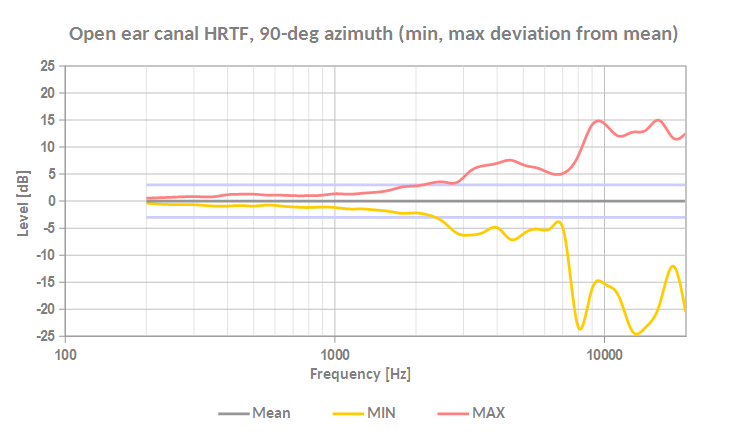
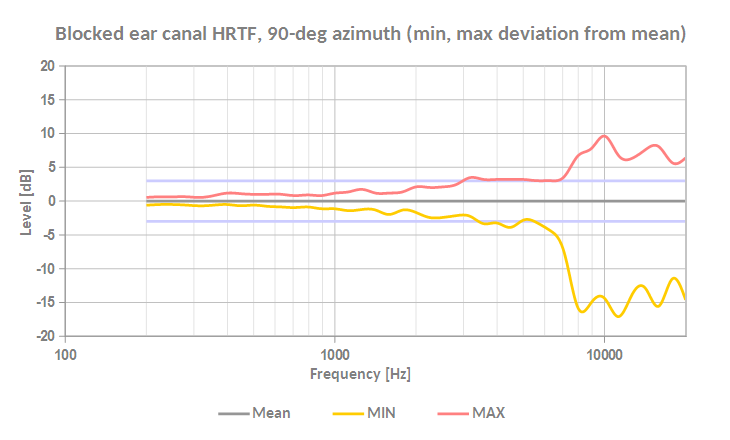
The previous graphs show the minimum and maximum deviation between 40 subjects for blocked and open ear canal measurement (90 degree azimuth). The graphs were created from fig. 24 from this study by subtracting the mean value. (Large peaks were removed during the conversion, so there is some smoothing applied in the graph.) The uncertainty created by anatomical differences becomes really an issue from 6 kHz. This high-frequency region is also associated with presence - or the lack of presence if attenuated.
How to connect these graphs with headphone and earphone measurements? The expected min/max deviation in IEM, earbud and small on-ear headphone measurements is similar to that shown in open ear canal HRTF min/max graph (this is also the worst group with the largest deviation). For large on-ear headphones the blocked ear canal HRTF min/max graph provides some direction. For over-ear headphones the blocked ear canal HRTF min/max can be used as a guideline by expecting slightly lower standard deviation.
Ear canal resonance in headphones
The recreation of the open ear canal resonance has one requirement: free termination of the ear canal. This can be achieved with a relatively large coupling volume and keeping the headphone driver some distance from the entrance of the ear canal. Typical values for ear canal volume are between 0.6–2.5 cm3 for adults (Google said...). The coupling volume (which includes the concha, a ~2-4 cm3 cavity tightly coupled to the canal) should be much larger than this value. The volume of a very small over-ear headphone cup is about 12 cm3. In small on-ear headphones the ear canal is partially occluded, so probably open and closed resonances (half wave and quarter wave resonances) coexist.
Measuring ear canal resonance ("ear canal response") in a headphone requires two measurements: a flat plate measurement and a measurement with an ear canal simulator. We can determine the ear canal resonance by subtracting the flat plate response from the ear canal simulator response.
We can use an alternative method, if PRTF (Pinna Related Transfer Function, discussed in next chapter) and complete artificial ear response at the eardrum reference point (DRP) are available. By subtracting the PRTF and flat plate response from the DRP measurement we get the ear canal resonance. For small on-ear headphones we can use a simplification: since the PRTF of these headphones is flat between 1 kHz and 6 kHz, the pinna used in PRTF measurement and in dummy head measurement can be different.
The following two graphs show ear canal excitation measurements for various over-ear and on-ear headphones. The PRTF and human manikin measurements are from rtings.com, flat-plate measurements are from diyaudioheaven (I recommend these websites either you want to buy a headphone or just want to learn about headphones). The headphones used for generating these graphs are not exactly the same (same type, but different serial number) which introduce some error due to manufacturing inconsistency. However, these graphs reveal a lot...
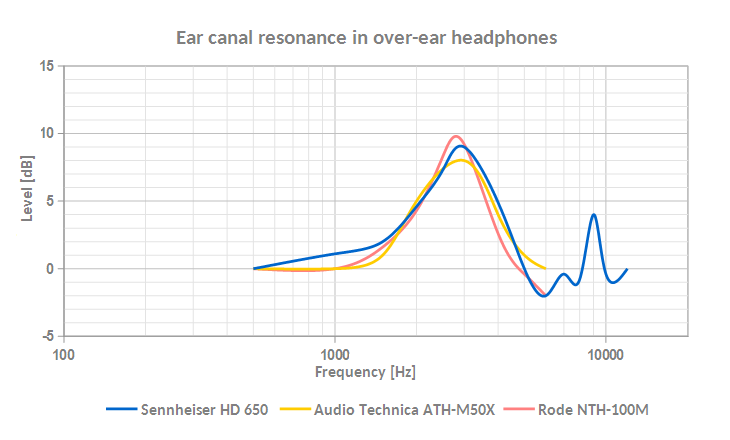
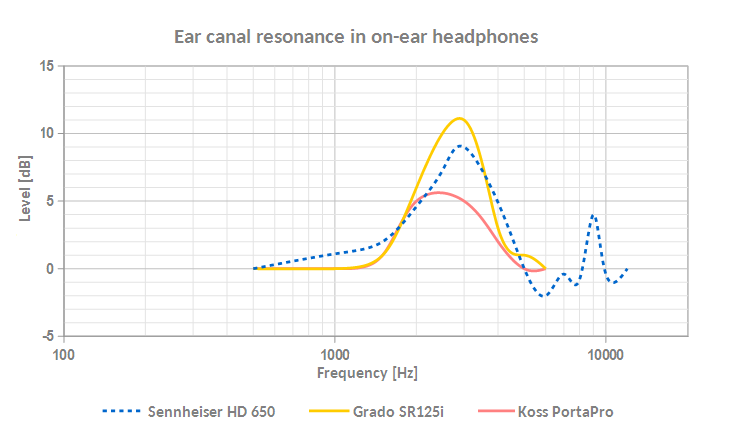
Note, that not only over-ear headphones can excite the ear canal resonance, but even a large on-ear headphone (Grado SR125i). However, the small on-ear headphone (Koss PortaPro) seem to have difficulty in exciting the resonance.
Here comes the trouble: our concha
So, the good news is that individual differences in ear canal anatomy don't affect the reliability of over-ear headphones' measurements. This also means that the ear canal is not required for accurate measurement of over-ear headphones. Unfortunately, the behavior of the concha is not so simple.
PRTF stands for Pinna Related Transfer Function, though the response of the pinna (especially the diffuse response) is mainly determined by the gain from the concha. The contribution from the other parts of the ear (e.g. Helix) to the diffuse-field PRTF response is minimal.
PRTF is the difference between the response of the headphone with pinna and without pinna (how PRTF is measured is explained in detail here). Majority of over-ear headphones have a good PRTF (follows the target), whereas on-ear headphones have a flat or almost flat PRTF. Rtings uses PRTF, though they use if for soundstage and not for ear compatibility.
Defining a target for PRTF is not a simple task since PRTF is a function of direction as opposed to ear canal resonance. Since the baseline curve for headphone targets is the diffuse-field HRTF, it's reasonable to choose the diffuse-field PRTF for the target. However, since headphones can't create a diffuse field, a free-field response similar to the diffuse field target is also a good option. We can find such responses from direction between 30 and 45 degrees.
The other problem with PRTF measurements is that artifacts inherently present in flat plate measurements are also included in PRTF measurements. This behavior also depends on the quality of the ear pad and transducer. Some headphones are better and some headphones are worse in this regard. However, there is no PRTF measurements which measures PRTF only.
The distance between the microphone and the transducer may differ when the headphone is measured without pinna and with a pinna. However, the change in distance will be reflected in the PRTF: the PRTF between 500 Hz and 1 kHz should be zero. An offset in this region indicates that the distance has changed. Besides, the difference between the two distances is more of a problem with on-ear headphones. With over-ear headphones the distance doesn't change too much.
Thought experiment with loudspeakers - illustration of the problem
The challenges of headphone measurements can be illustrated by the following example (thought experiment) using loudspeakers. Suppose we are measuring loudspeaker responses at the eardrum (Drum Reference Point, DRP) with a head and torso simulator and we define our DRP target response 30 degrees off axis (the actual target is not important in this example). The DRP target also defines a PRTF target and a target axis which will be 30 degrees off-axis.
Let's analyze the response of a loudspeaker placed 30-degree off-axis. If the loudspeaker has flat response, the measured response at the DRP is the DRP target. If the loudspeaker has non-flat response, then errors can be corrected from the dummy head measurement because the PRTF still follows the target PRTF (DRP response is poor, but the PRTF is good). With good PRTF the deviation from the target can be attributed to the loudspeaker and measurements are transferable from ear to ear.
By moving the loudspeaker and changing the direction, the PRTF also changes and starts to deviate from the target PRTF. Measurements are not transferable to other ears any more since we don't know from one DRP measurement that the artifact should be attributed to the loudspeaker or to the "modified" PRTF. Even a good DRP response not necessarily follow the target with a different ear.
Note, that the analogy is based on the notion that a target HRTF and a target PRTF exist and are related.
Things get more complicated with headphones, as PRTF is also a function of distance (near field PRTF). In addition, two ears of similar size and geometry may have slightly different sound absorption, which can affect the reflections generated in the headphone cup. Although the headphone driver is close to the ear, the near field of the concha is quite small (perhaps 3 cm) and at least the driver of over-ear headphones is located in the transition between the near and far fields (otherwise it would be impossible to achieve good PRTF with headphones).
| DRP response | PRTF | Comment |
| good | good | measures good an all ears |
| good | bad | measures good on one ear |
| bad | good | can be corrected for all ears |
| bad | bad | can be corrected for one ear |
Note: in the comment column "can be corrected for all ears" and "can be corrected for one ear" is meant with one artificial ear measurement.
PRTF and out-of-head localization
Since PRTF is a function of distance and direction, it makes sense to connect out-of-head localization with PRTF. Fortunately, PRTF (and personal HRTF) is only important for out-of-head localization of anechoic sounds. Adding uncorrelated reverberation to a recording can greatly improve out-of-head localization with headphones. Reverberation is necessary, because out-of-head experience of reverberation free (anechoic) sounds is very subtle, even with the largest headphones (the distance between the headphone driver and concha is only a few centimeters, even with the largest ones).
While headphones can't create a realistic frontal image, they can simply create surround sound using standard stereo recording techniques and reverberation. When reverberation is added to a recording or the performance is recorded with natural room reflections, PRTF becomes secondary, since in this case binaural processing of uncorrelated reverberation generates the out-of-head experience and not pinna reflections. Pinna reflections are useless in a highly reflective room, except at the onset of the sound, when only the direct sound is heard. Enveloping sounds, concert hall recordings always sound a bit out-of-head and distant regardless of transducer type.
Surround sound with headphones and traditional stereo
Some audio examples are available in my movie soundtrack compilation.
Examples: Funeral March of a Marionette, Star Wars (Main Theme), Star Wars (Bad Guy Theme), Mission Impossible 5-6-7-8.
The out-of-head experience is not constant, it changes with the instrument and reverb level. Strings, horns are easier to externalize than plucked or percussive sounds.
Size of the transducer is also an important factor. Above about 8 kHz, large headphones with large transducers emit sound waves that are more like plane waves, similar to when the sound source is far from the ear. To understand why the diameter of the diaphragm matters, we need to take a closer look at the radiation of different sources. A point source creates spherical waves in its immediate vicinity. As the waves propagate further from the source, they gradually turn into plane waves. It's also well known that the radiation angle of a real sound source starts to decrease above a certain frequency (this phenomenon is called "beaming" or "lobing"). What is more important is that in this frequency range the sound source generates plane waves even in its near field! This means that the sound waves appear to originate further away from the source. The acoustic distance is larger than the physical distance... (Note: cone break-up modes can change this behavior, besides, the question is not whether the sound source is a point source or a 50 mm driver, but whether the source is a 30 mm or 50 mm driver.)
Here is a demonstration with Ripple Tank simulator (animated image).
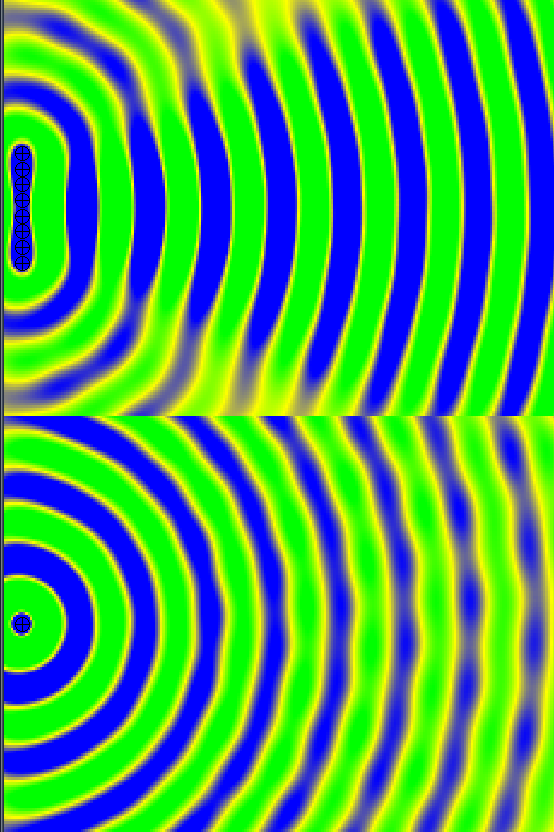
The next step would be a finite element analysis with a realistic model of a headphone driver, or reverse engineering the sound field from directivity plots / polar diagrams (since there is a strong connection between DI and generated sound field...).
Additional notes
Deficient or flawed headphone/earphone outer ear responses can be divided into two categories. One type when the inadequate outer ear response is different for all people: for example IEMs "faked" ear canal resonance varies from person to person. The other type when the flawed outer ear response is the same for everyone: concha gain with IEMs and small on-ear headphones is zero for everyone. The second type of error is easier to handle.
I have omitted the discussion of ear canal impedance for a very simple reason: it is not relevant here. Impedance of the ear canal is important if we want to model the outer ear response with a software. However, since any change in impedance results in a change in the frequency response near the resonance frequency of the ear canal and since what we hear is the change in frequency response, we can omit impedance calculations and measurements, and focusing on what is directly audible: frequency response. (What we actually hear are the harmonics and their relative levels, which means that frequency response is the related measurement. It seems to me that acoustic impedance is a common "throw in" terminology to look scientific. Problems in headphones can be studied either per frequency range or per "subsystem" (ear canal, pinna, low frequency leakage, etc...).)
Summary
Keypoints:
- Because of anatomical differences between people, there are individual differences in human HRTFs. These differences become significant in the high frequency range (typically above 6 kHz).
- Individual differences (differences in HRTFs) don't directly translate to the differences of a headphone's measurements on different ears. It also depends on the "outer ear excitation" or transducer coupling to the ear.
- The excitation of the outer ear plays an important role in how the headphone performs with other ears.
- The outer ear excitation can be divided into ear canal resonance and concha response. They can be measured independently or simultaneously.
- Over ear headphones and even large on-ear headphones can excite our natural ear canal resonance. The uncertainty in measurements can be attributed to anatomical differences in the pinna (on the human side) or poor PRTF (on the headphone side).
- IEMs and small on-ear headphones have flat PRTF (poor outer ear excitation) with an unnatural coupling to the ear canal. Therefore, the reliability of artificial ear measurements is lower than the reliability of over-ear headphones' measurements.
Final notes
I wrote this article primarily (and ironically) to support my flat plate measurements. It wasn't planned in advance. Since the ear canal and concha is missing in flat plate measurements, it's worth knowing their effect and how far we can get with a flat plate fixture.

References
- Head-related transfer function (Wikipedia)
- "Head-related transfer functions of human subjects", Hammershøi, Møller, Sørensen, Jensen, 1995
- Pinna (Wikipedia)
- Our PRTF Scores And Tests (rtings)
- "Determination of noise immission from sound sources close to the ears", Hammershøi, Møller, 2008
- "Characterizing and conserving the transmission properties of the external ear with hearing devices", Florian Denk, 2020
- "The Subjective and Objective Evaluation of Room Correction Products", S.E. Olive, J. Jackson, A. Devantier, and D. Hunt, 2009
See also:
Headphone measurements: with or without ear?
Panasonic RP-HT710 and Sennheiser HD 419 (flat-plate measurements)
Headphones & amplifiers - output impedance, load impedance and frequency response
Audio measurements & fidelity: the ten basic rules
Beyond directivity index and room response
Lossy audio compression: principles, methods, misconceptions 🔊 🎧
