Headphone measurements:
with or without ear?
Can we predict the sound of headphones from flat-plate measurements, and if so, with what type of headphones? Headphone measurement with flat surface fixture - without pinna and ear canal. Reliability, accuracy, target curves, problems and solutions.
May 28, 2026
Sometimes simplicity is the key to a problem, or at least we should consider it as an alternative option. Flat plate fixture is the simplest "headphone-ear coupler", yet it gives a good prediction of how headphones sound, especially for over-ear types. Thanks to the complex interaction between the pinna and the headphone, both dummy head and flat plate measurements loose accuracy and become ambiguous in the high treble range. Moreover, a huge benefit of flat-plate measurements is that the measurement rig costs almost nothing as opposed to dummy head systems.
Unfortunately, there is a lot of noise in this research field. There are plenty of preference studies without any attempt to understand headphone acoustics or headphone-ear acoustics. How the resonance of the ear canal changes as a function of distance? How the gain from the concha changes as a function of distance? How to get a consistent sound and consistent compensated frequency response with a headphone? How to transform engineering "know-how" into well-grounded science? The other problem is that a subjectively preferred target isn't necessarily the "neutral sound curve" due to the lack of reference. There is a good correlation between sound preference and fidelity when the coloration is significant (e.g., 6 dB bump at 1 kHz), but when the coloration is just minor - say three decibels? Consider adjusting the colors on a TV using purely subjective methods, without any reference. How far can you get with an adjustment method if the goal is neutral color display? (We can call this problem in audio as the "problem of the last three decibels".)
Introduction - a short overview of headphone measurements
For headphone measurements we need a device that acoustically couples the headphones to the measurement microphone, that is, provides a similar acoustic environment for the headphones as when they are on our head. Headphones are, therefore, usually measured with an artificial ear mounted on a dummy head (Head And Torso Simulator, HATS) with the microphone placed in the eardrum reference point (DRP). We could measure headphones on real human subjects, but this method is very inconvenient (blocked ear canal measurements). If we remove the ear canal and the pinna from the measurement, we get a flat plate measurement. Flat plate measurement gear can be made of two small wooden panels held together by a wooden strip. You can find loads of flat plate measurements at Diy-Audio-Heaven.
The benefit of measurements with a human manikin:
- They show the response with an average ear at the drum reference point. The response and correction is valid for many people.
The benefit of flat plate measurements:
- They show the response of the headphone cup and driver only, the "uniform component".
- The measured frequency response does not change significantly for each reseats. Check out this reddit thread. (Note: this doesn't fully apply to small on-ear headphones.)
- Simple as can be. It has no ear canal, pinna. There are no different versions, it is a universal system. (The distance between the wooden boards affect the force applied to the headphone cups, which may influence the low frequency response. The material also has tiny effect on the response, however, there is no big difference even between cardboard and wood.) (Note: assuming correct calibration or microphone... Electret capsules from old tape recorders can only be used up to 3 kHz without calibration.)
Similar to loudspeaker measurement, headphone measurements require a target curve. When headphones are measured on a dummy head, the target is based on the transfer function of the outer ear (slightly modified diffuse-field HRTF, see head-related transfer function in Wikipedia). Measured responses are compared to the target and the deviation from the target can be used as a rating. Besides, correction curves can be generated from the difference.
A major issue with headphones is how to transfer the measurement results from one measurement rig to another. Not only the target response, but above ~2 kHz even the deviation from the target may vary from ear to ear as well.
Transferability of measurements (~ relevance of measurements on different ears) depends on the headphone and not on the measurement system. Transferability depends on how the headphone can excite ("recreate") our personal ear canal resonance and concha response (the latter is expressed as PRTF, Pinna Related Transfer Function). Assessment of the ear canal component is not complicated because it is independent of direction, but the concha response varies with direction. (Relevance of headphone measurements on human ears is discussed in this article.)
| Category | Ear canal resonance | Concha response |
| In-ear monitors (IEMs) | "faked" response | ❌ |
| On-ear headphones | partial response | ❌ |
| Over-ear headphones | similar to free-field | depends on cup size |
In-ear monitors replace the ear canal resonance with a "closed-box" type resonance and a higher frequency half-wave resonance. With good sounding IEMs the closed-box type resonance adds a similar boost as the ear canal resonance. Close but not the real thing. Small on-ear headphones create an ear canal resonance that is “partial”, however, the problem is that it is not a consistent, predictable response as a real resonance. Large on-ear headphones and over-ear headphones can recreate the free-field ear canal resonance.
As a rule of thumb, individual differences in ear anatomy are less important with large over-ear headphones than with on-ear headphones, IEMs, or earbuds (size matters). Over-ear headphones are a good candidate for flat-plate measurements, measuring small on-ear headphones is bit of a trying to squeeze a square peg in a round hole. However, the uncertainty in the high-frequency region exists both with flat-plate and HATS measurements.
The following table shows he highest frequency up to which a headphone's or earphone's fidelity can be determined from measurement with a ±3 dB margin of error. Above this frequency, individual differences start to mess up the measurements and cause more than ±3 dB deviation in the responses.
| Category | Frequency of reliability for ±3 dB tolerance |
| Small on ear headphones, IEMs, earbuds | 3 kHz |
| Large on-ear headphones | 6 kHz |
| Over-ear headphones | > 6 kHz |
Note for over-ear headphones: the frequency is probably slightly higher than 6 kHz, depends on the size of the headphone cup, geometry of the cup, transducer design, etc.
Shortcomings of flat plate measurements
We have to pay attention to these problems when choosing flat plate measurements:
- Flat plate measurements tend to overestimate the response below 200 Hz. Seal is usually greater on a flat plate rig than with real or silicone ears. Solution: measure the bass response with a silicone ear.
- High-Q driver resonances (narrow dips and peaks in the response) are very sensitive to the damping properties of the surrounding (coupling device). Pinna is a good diffuser-absorber and damping is different on a flat-plate and with ear (real or silicone ear). A real or silicone ear can slightly attenuate ("smear") high-Q resonances compared to flat plate. Partial solution: response smoothing or ignoring narrow peaks and dips. (Note: this is a minor issue, not a serious one, as only affects high-Q resonances.)
- Standing waves between driver and panel that holds the microphone. For a 2 cm distance (depth) the frequency of the first standing wave is 8.5 kHz. As far as I'm concerned, standing waves don't seem a serious trouble, mainly because earpads provide sufficient damping. However, this is still an open question. The ultimate solution would be measuring a driver with flat response between 5 kHz and 13 kHz (+- 1 dB), but it's impossible to find such a headphone driver. We can compare free-air measurements with flat plate measurements, but it's difficult to give clear answers.
Diffuse-field target for flat-plate measurements
Diffuse-field curve is of central importance because it serves as a basis of headphone target curves. For HATS measurements the diffuse-field curve is the diffuse-field response of the head and torso simulator (measured or calculated). For flat-plate measurements the diffuse field target is the diffuse-field response of a microphone mounted on a sphere with the size of an average human head plus torso. Or to put it another way, the diffuse field response of a manikin without ear canal resonance and pinna response.
In diffuse field the effect of the head and shoulders is a 3 dB slope between 150 Hz and 800 Hz. For a frontal wave in free field the slope and the gain is similar (~3 dB). For a sound wave from the side (90 deg azimuth) the gain is 6 dB. In contrast, when the driver is close to the ear, the gain from the head and shoulders is zero (actually same all frequencies). Headphones bypass the diffraction from the head, but this doesn't change the diffuse-field target.
The gain from the head and shoulders can be analyzed with blocked ear canal measurements. Since the pinna has no contribution to the head-related transfer function below 1.5 kHz, the blocked ear canal measurement up to 1.5 kHz includes only the effect of the head and shoulders. From 1.5 kHz, gain from the head and shoulders can be considered constant.
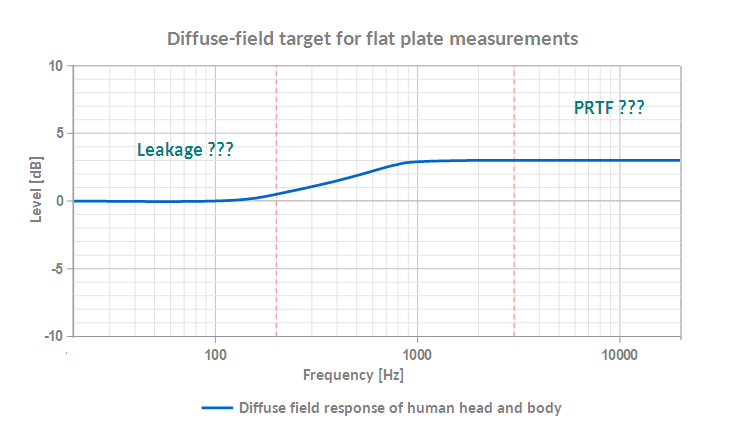
The response can be divided into three zones. Below 200 Hz leakage affects the final response, above 3 kHz differences between pinna (actually concha) responses cause uncertainty (assuming a typical over-ear headphone). Between 200 Hz and 3 kHz the interpretation of the measured response is simple and doesn't require additional measurements.
Loudspeaker response equivalent of flat response on a flat plate rig
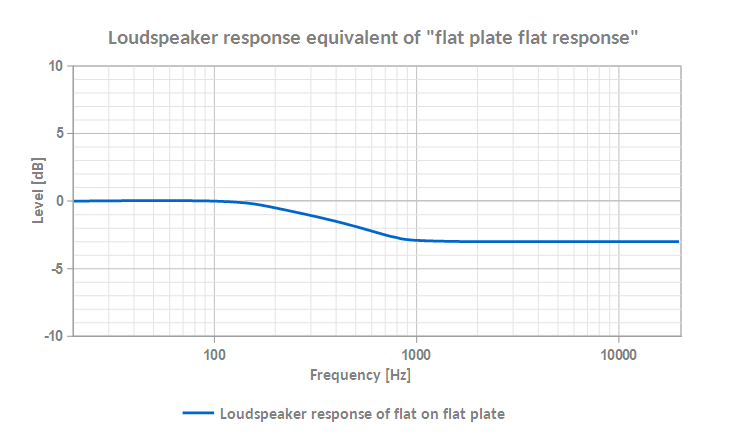
What is the loudspeaker response equivalent of a headphone that measures "flat" on a flat plate rig? Flat response on a flat plate corresponds to a 3 dB gradual attenuation between 150 Hz and 1 kHz in a loudspeaker response (the inverse of the diffuse-field target shown in the previous graph). Similar tilt present in the Harman room response in this region.
High-frequency correction for flat-plate measurements
Electret microphone capsules are calibrated in free field. However, when a microphone equalized to flat frequency response in free-field and mounted in a large baffle (or flat plate), the response will show a roll-off depending on the diameter of the microphone.
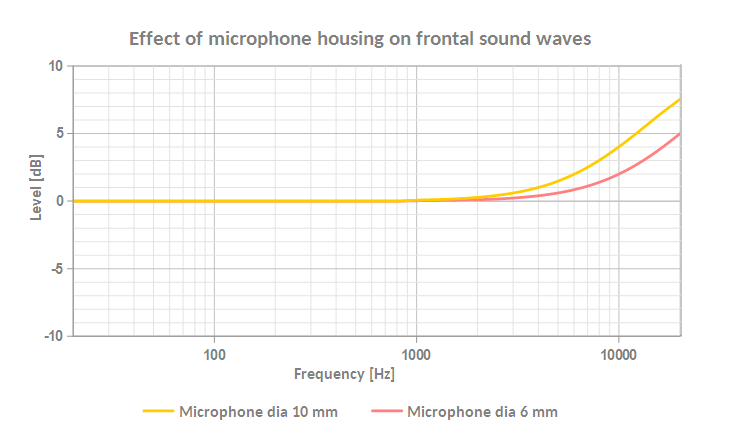
Surface mounting a microphone creates a roll-off in the response, which can be explained with the directional characteristics of the mic. A 10 mm electret microphone captures sound from all directions below 5 kHz. From 5 kHz the spherical pick-up pattern gradually changes to hemispherical and becomes hemispherical at 20 kHz. The change in the pick-up pattern results in a 6 dB gain for frontal waves, often with an extra ~ 3 dB bump above the transition. When microphones are intended to be used in free-field, the capsule is designed to have a flat (or almost flat) response in free field. Free-field calibration also corrects the response to flat for frontal waves. However, when mounted in a wall, the pressure is doubled where the pick-up pattern is spherical. At very high frequencies the pressure is not changed, the wall has no contribution to the pressure because even without the wall the pick-up pattern is hemispherical.
This is similar to when a baffle step compensated loudspeaker is built in a wall...
The gain for frontal waves in free field, calculated with Edge baffle diffraction simulator:
Measurement:
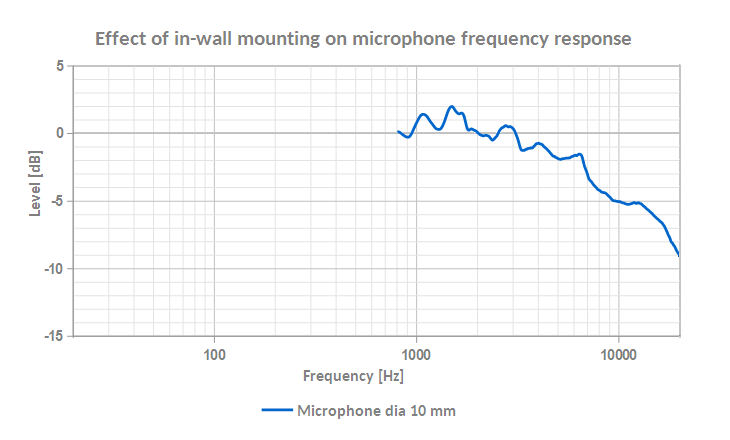
One solution is to modify the target with the high-frequency roll-off (since the attenuated response is the flat on a flat-plate...). An alternative solution is to add the high-frequency attenuation to the microphone calibration file. The third method is to calibrate the microphone as a pressure microphone, but this solution requires a relatively large baffle.
Correction curves:
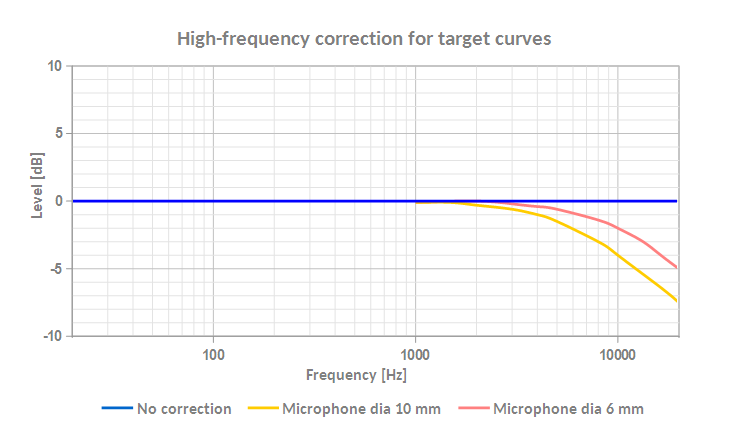
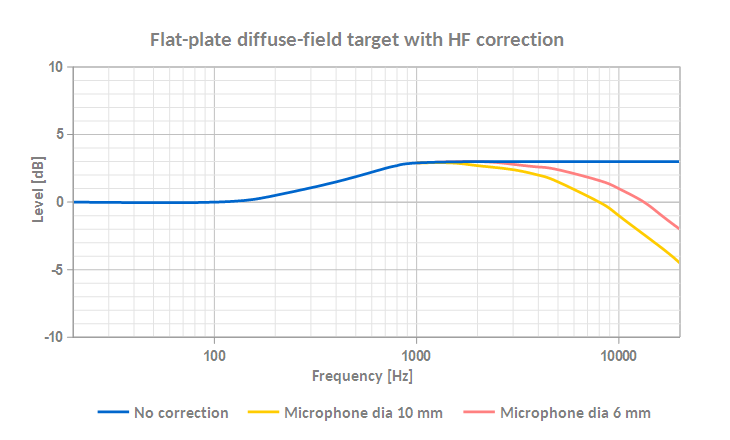
HATS measurements are free from the previous problem since target curves are generated with an equalized loudspeaker. Besides, head and torso simulators have microphones calibrated to a flat pressure field (called WS2P category microphones). However, we can't generate target curves for a microphone mounted in a box with an equalized loudspeaker due to edge diffraction, though we can calibrate a microphone mounted in a sphere.
Flat plate target for on-ear headphones
On-ear headphones (Koss Porta-Pro type headphones) lack concha excitation and have a flat PRTF up to 10 kHz. Therefore, the concha gain has to be built in the flat plate response - the headphone has to "simulate" or "fake" the missing concha gain. We can use the blocked ear canal diffuse-field response as a target for on-ear headphones (blocked ear canal diffuse field HRTF is from Hammershøi, Møller, 2008, this is a human average).
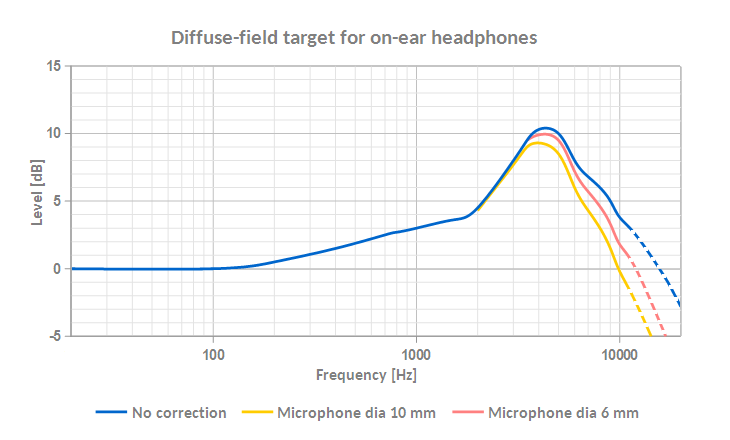
And the target without the three decibels diffuse-field head and shoulder gain ("Harmanized" version):
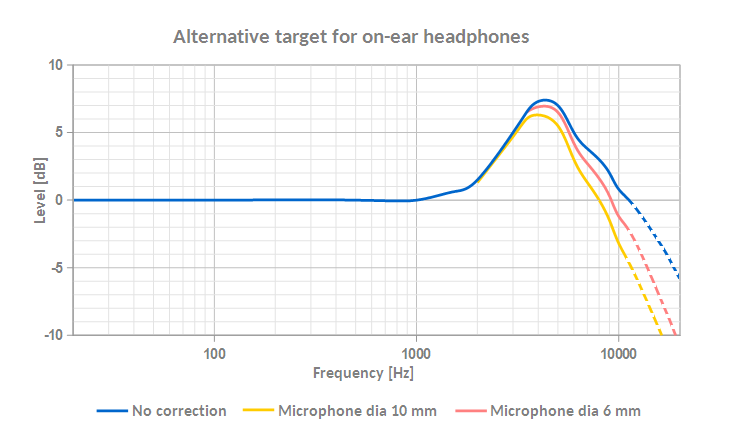
Another method is to equalize the response to flat on a flat plate fixture. After equalization, adjust the missing concha gain with music by gradually boosting the frequencies around 4.5 kHz, similar to the graph (the Q of the concha response simulation filter is 0.9). Note that this fine-tuning doesn't work with over-ear headphones, as they can recreate the concha gain, although the accuracy depends on the headphone.
Measurements in the low frequency range
Added on 2026.07.21.
Measuring low frequency performance is the weakest part of flat plate measurements. One solution is using a silicone ear, the other solution is using a compensation curve for flat plate measurements (lowering the bass boost by adding the "flat plate minus silicone ear" response to the microphone calibration file below 500 Hz). However, the difference between flat plate and silicone ear (or real ear) depends on the size and design of the ear pad. (If we measure similar headphones, we can use one compensation curve for them).
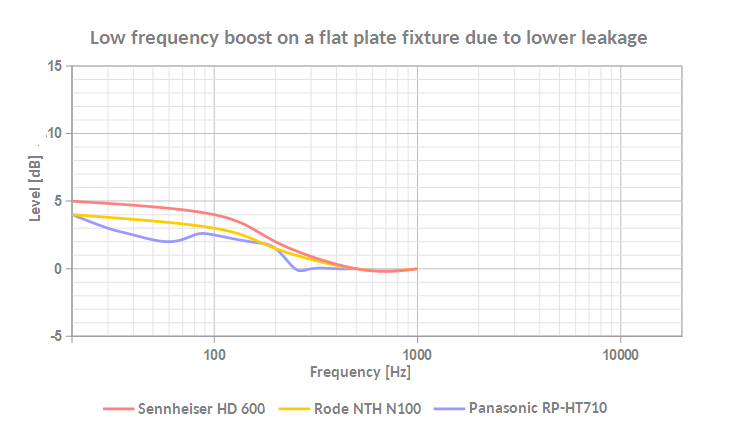
The curves for Sennheiser HD 600 and Rode NTH N100 are based on raw responses from SupOrSalad, Panasonic RP-HT710 is based on my in ear measurement.
Internal reflections (standing wave resonances)
Added on 2026.07.21.
Though the following is still not a detailed analysis of standing waves, I made a simulation with two reflective walls. The microphone is located on one wall, the sound source is located on the other wall. It seems that the bump created by the resonance with completely reflective walls is 6 dB "only". While this is a significant error, if we take into account that a headphone also absorbs some energy, this will be attenuated with a couple of decibels. So the peak is likely lower than 6 dB.
The slope between 300 Hz and 2 kHz is part of the headphone response even with a human head, so this is not an "artifact" (of course the reality is more complex).
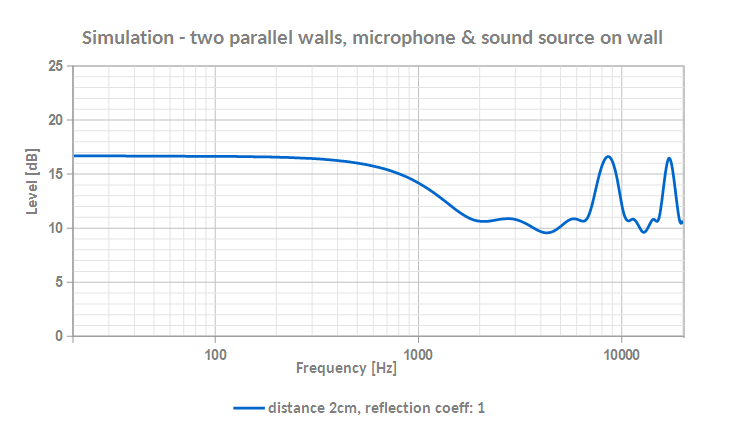
Though the simulation is inherently time-windowed, the last modeled reflected pulse only increases the resonance by +0.14 dB.
Additional notes on errors from headphone reseats
A huge benefit of flat plate measurements is the negligible frequency response difference when headphones are reseated. One could also argue that this is also a disadvantage, as we cannot measure the consistency of headphones with a flat plate fixture (consistency is expressed with the deviation from the average response).
However, errors from reseats can be viewed in another way. Repositioning errors can be considered partly a measurement artifact in artificial ear measurements, as humans can automatically adjust the headphone to get the best sound (the best sound is the most bass and treble). In artificial ear measurements there is no direct feedback (from the dummy), so the response has to be averaged. (Note: the previous statements do not fully apply to small on-ear headphones, nor do they apply if the headphones are intentionally placed incorrectly.)
Diffuse-field or "flat on flat plate" - which equalization is better?
The difference between the two targets is very small. I found the diffuse field equalization to be better with acoustic instruments and isolated speech, while the flat target is more suitable for pop-rock. The diffuse field equalization seems just a little nasal and less comfortable with pop-rock.
Summary
As a brief summary of the above, the list of the key points:
- Based on the diffraction created by the head and shoulders, we can define a diffuse field target for flat plate measurements. This target corresponds to a flat response with loudspeakers.
- A headphone that measures "flat" on a flat plate rig is equivalent with a 3 dB gradual attenuation between 150 Hz and 1 kHz in a loudspeaker response.
- Microphones must be calibrated in a pressure field. If free-field calibrated microphones are used, a correction must be applied.
- Flat target for on-ear headphones results in attenuated high frequencies. For on-ear headphones a different flat plate target can be defined, or the original target can be mixed with an adjustment method.

References
- Head-related transfer function (Wikipedia)
- Raw frequency response (rtings)
- Pinna (Wikipedia)
- Our PRTF Scores And Tests (rtings)
- "Determination of noise immission from sound sources close to the ears", Hammershøi, Møller, 2008
- "Characterizing and conserving the transmission properties of the external ear with hearing devices", Florian Denk, 2020
- "The Subjective and Objective Evaluation of Room Correction Products", S.E. Olive, J. Jackson, A. Devantier, and D. Hunt, 2009
See also:
Headphone measurements: what outer ear measurements can tell us
Headphones & amplifiers - output impedance, load impedance and frequency response
Panasonic RP-HT710 and Sennheiser HD 419 (flat-plate measurements)
Audio measurements & fidelity: the ten basic rules
Beyond directivity index and room response
Lossy audio compression: principles, methods, misconceptions 🔊 🎧
